Invasive species are a major element of global change and are contributing to biodiversity loss, ecosystem degradation, and impairment of ecosystem services worldwide. Research is shedding new light on the ecological and economic consequences of invasions. New approaches are emerging for describing and evaluating impacts of invasive species, and for translating these impacts into monetary terms. The harmful effects of invasions are now widely recognized, and multiscale programs are in place in many parts of the world to reduce current and future impacts. There has been an upsurge in scientific research aimed at guiding management interventions. Among the activities that are receiving the most attention and that have the most promise for reducing problems are risk assessment, pathway and vector management, early detection, rapid response, and new approaches to mitigation and restoration. Screening protocols to reduce new introductions are becoming more accurate and have been shown cost-effective.
INTRODUCTION
The extent of biological invasions has increased rapidly over the past half century (1, 2, 3). Along with other drivers of ecosystem degradation such as habitat change and exploitation, environmental pollution, climate change, and associated effects, including the loss of keystone species, loss of pollinators and altered ecosystem functioning . biological invasions contribute to the decline of biodiversity worldwide . With increasing awareness of the complexity of problems with invasive species, invasion ecology has taken its place at the table with other disciplines in environmental management that have themselves evolved in response to challenges in biodiversity conservation . Invasion ecology has exploded to embrace and borrow insights, methods, and approaches from biogeography, conservation biology, epidemiology, human history, population ecology, and many other domains. This reflects the massive increase in the number and extent of invasive species and invasion events worldwide, as well as the radical escalation of the implications of invasions. Very few ecosystems anywhere in the world are free of introduced species, and an increasing proportion of biomes, ecosystems, and habitats are becoming dominated by introduced species.
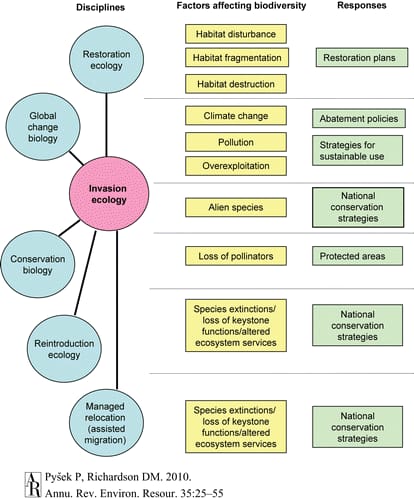
Negative effects on biodiversity are generally the main concern associated with biological invasions, but invasions also have serious implications for human well-being. Most humans rely on alien species for the bulk of their requirements for food and other basic requirements, although there is increasing realization of the importance of conserving natural capital to ensure the sustainable provision of crucial ecosystems services. The Millennium Ecosystem Assessment (2) recognized biological invasions as one of the five main causes of declines of biodiversity, which translates into reduced ecosystem services worldwide. The rank of invasions as a threat varies across biomes and is most serious in coastal areas, inland waters, and Mediterranean-climate zones as well as on islands. Invasions also have rapidly increasing impacts in biomes that are not yet seriously affected, e.g., dryland and forest zones. Economic costs to society of harmful invasive species involve those associated with losses of biodiversity and impaired ecosystem services, as well as the costs of controlling invasive species and reducing and mitigating their impacts. Synergistic interactions between invasive species and other elements of global change make it difficult to assign a rank to specific causes of biodiversity decline, but invasions are a fundamental driver of ecosystem degradation in many parts of the world. Invasion ecology, and the management of invasions, now grapples with the extreme complexity implicit in gaining a predictive understanding of the spatial dynamics of invading species, the range of interactions between nonnative species and natives, the effects of invading species on biodiversity and ecosystem functioning, and the full range of human values associated with decisions on whether and, if so, how to manage introduced species.
Why Invasions Happen: Key Concepts
Much work has been done in recent decades on every conceivable facet of invasion ecology (5, 6, 7), and our understanding of why invasions happen has improved substantially. Three big questions underpin most work in invasion ecology: Which species invade; which habitats are invaded; and how can we manage invasions? Some organizing and unifying themes in the field are organism focused and relate to species invasiveness; others are ecosystem centered and deal with determinants of the invasibility of communities, habitats, and regions. Recently, some theories have taken an overarching approach to plant invasions by integrating the concepts of species invasiveness and community invasibility (5).
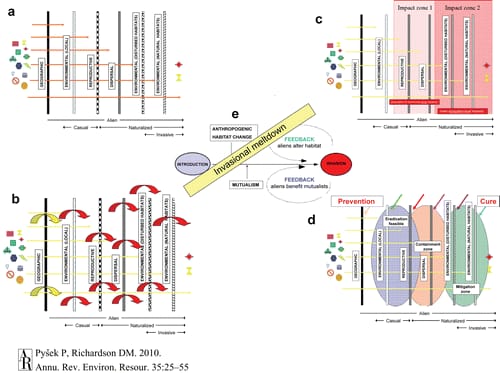
The process of invasion can be conceptualized with reference to the naturalization-invasion continuum (Figure 2a), which posits that an alien species needs to overcome a sequence of barriers to become naturalized or invasive (5, 8). A species is introduced from a region where it is native by means of human action via various pathways, including both deliberate introduction and release into the wild, and unintentional introduction (9). Only a fraction of introduced species successfully establishes or invades in the new region . Whether or not they succeed depends on how their biological traits equip them for dealing with the rigors of the new environment, whether they are able to reproduce, disperse, and successfully compete with resident biota in local communities (11, 12), but also on the habitat and climate match between the native and invaded region and on the invasibility of recipient communities. Traits contributing to the success of taxa as invasive aliens are not universal and need to be related to the features of the invaded community, geographical conditions, and a set of external factors, including propagule pressure (5). In the new region, synergistic interactions may occur among invaders that accelerate invasions and/or amplify their effects on native communities . Stochastic effects, which depend on initial inoculum size, residence time (i.e., the time since the introduction of a taxon to a new area), chance events, and propagule pressure (defined as the number of introduction events) , and their spatial distribution codetermine whether a species becomes invasive. A key generalization is that the probability of invasion increases with residence time.
An introduced species invading a new region must either possess sufficiently high levels of physiological tolerance and plasticity, or it must undergo genetic differentiation to achieve the required levels of fitness; these options are not mutually exclusive. Available evidence suggests that some invaders are “born” (released from fitness constraints), that some are “made” (they evolve invasiveness after colonization), and that the relative importance of ecological and evolutionary forces is unique to each invasion episode. It has been shown that evolution, as a potential explanation for invasion success, can be rapid enough to be relevant over the timescales at which invasions occur. Hybridization is an important mechanism of evolution of invasive plant species, and many widespread, successful plant invaders are recently formed allopolyploid hybrids . Escape from natural enemies is another important mechanism leading to evolution of invasiveness; plants introduced into an environment that lacks such enemies may experience selection toward allocating less energy to defense and more to growth and reproduction . Enemy release is greater in plant species adapted, in their native range, to resource-rich environments, and these species are likely to become invaders because of their capability for fast growth. Therefore, enemy release and resource-use efficiency act synergistically
https://www.annualreviews.org/doi/10.1146/annurev-environ-033009-095548
Suraj yadav
KES Shroff college

